
Char Dham covers four shrines — Yamunotri, Gangotri, Kedarnath and Badrinath — all sitting above 3,000 metres in the Garhwal Himalayas. The route usually starts from Rishikesh or Haridwar. Weather at that altitude turns on you fast, so the month you pick decides more about your trip than the hotel you book. Most pilgrims aim for one of two windows: May-June, right after the temples reopen, or September into early October, once the monsoon clears out. Everything in between — deep monsoon, deep winter — carries real risk or isn’t an option at all.
Quick Answer
May-June and late September to mid-October are generally the more workable months for the Char Dham Yatra. July-August brings monsoon and landslide risk across the route. The temples close for winter around mid-November and stay shut until the following spring.
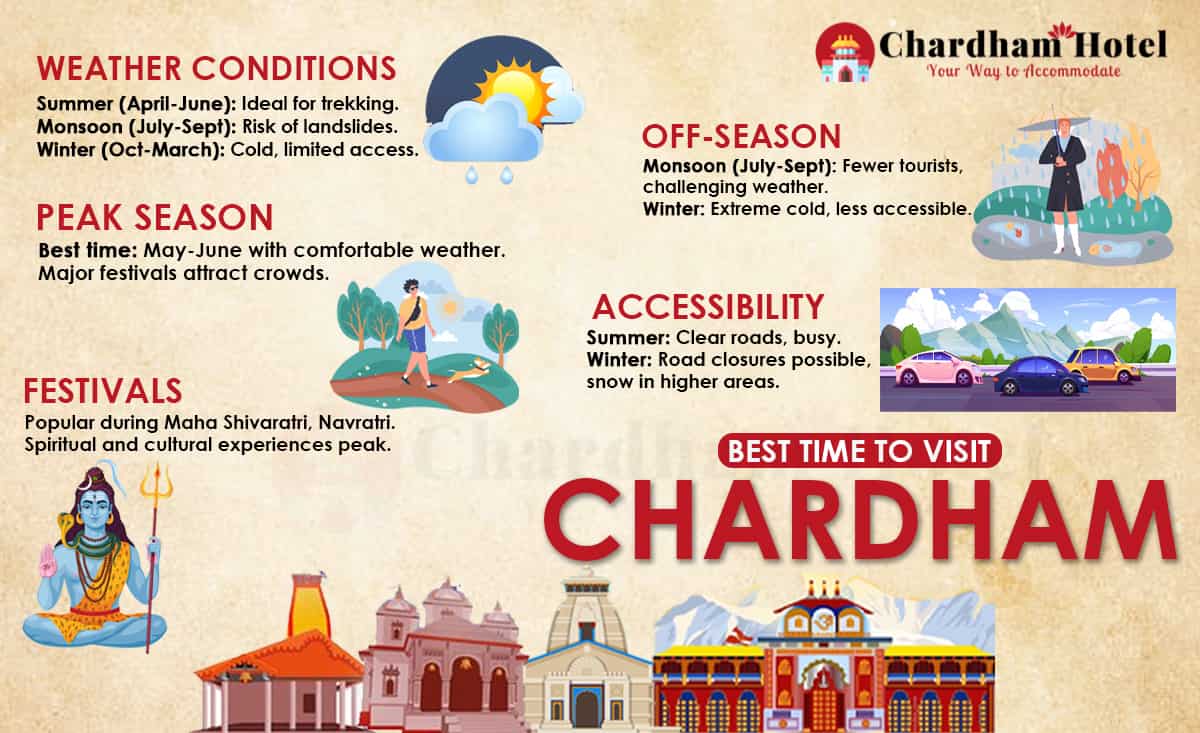
Char Dham Season at a Glance
| Season | Months | What to Expect |
|---|---|---|
| Summer | Late April – June | Roads reopen, temples at full capacity, heaviest crowds of the year |
| Monsoon | July – August | Rain, landslide risk, unpredictable delays |
| Post-Monsoon | September – mid-October | Clearer skies, thinner crowds, colder nights as the month goes on |
| Winter Closure | November – April | Temples shut, deities moved to winter seats |
Season-Wise Breakdown
Summer (Late April to June)
This is when most people go, and for good reason. The roads that were snowbound through winter reopen, and by late April all four shrines are functioning. Daytime conditions are workable across the route, though temperatures vary between the four dhams and drop sharply once the sun goes down. Kedarnath and Badrinath, being higher up, run colder at night than the lower stretches near Gangotri.
What you gain in stable weather, you lose in crowd size. May and June are peak season, which means the highest hotel rates of the year and longer queues for darshan. Booking accommodation three to four weeks ahead is worth it if you’re travelling in this window. Pack warm layers regardless of what the daytime temperature looks like on paper — nights at altitude don’t follow the same rules as the afternoon.




Monsoon (July to August)
July and August are technically open months. The temples don’t close. But this is the period to avoid if your dates are flexible — heavy rain raises the risk of landslides and road blockages across the Garhwal stretch, and conditions can shift within hours. If travel is unavoidable during this window, check road advisories daily, skip driving after dark on hill roads, and build slack into your itinerary in case of diversions.
Crowds thin out considerably during monsoon, and the hills turn genuinely green. That’s the real upside, and about the only one.
Post-Monsoon (September to Mid-October)
This window rewards patience. Once the rains taper off, the air clears and visibility improves noticeably. Fewer families travel during this stretch, and hotel prices come down from the May-June peak.
The trade-off shows up late in the season. Nights get colder as October progresses, and all four dhams begin closing between late October and mid-November — travelling too close to those dates leaves no room for weather delays. If you’re choosing this window, aim to finish by early October.
Winter Closure (November to April)
All four shrines close for winter, generally between late October and mid-November, once snow makes the routes impassable. The deities move to their winter seats, where worship continues without a break: Badrinath’s to Pandukeshwar and the Narsingh Temple in Joshimath, Kedarnath’s to Ukhimath, Gangotri’s to Mukhba, Yamunotri’s to Kharsali.
If you’re set on travelling in winter, the winter seats are a genuine alternative. They’re easier to reach, far less crowded, and carry the same religious weight, even though the main shrines stay locked until spring.
Altitude and Approach
| Dham | Altitude | Approach |
|---|---|---|
| Yamunotri | ~3,293 m | Janki Chatti + roughly 6 km trek |
| Gangotri | ~3,100 m | Motorable road |
| Kedarnath | ~3,580 m | Gaurikund + roughly 16 km trek |
| Badrinath | ~3,133 m | Motorable road |
We confirmed Badrinath’s altitude and road distances directly on the official Uttarakhand Tourist Care portal (registrationandtouristcare.uk.gov.in). The other three figures come from the same portal, though older Garhwal Mandal government pages list slightly different numbers for Kedarnath’s and Yamunotri’s trek distance — treat these as approximate rather than fixed, and confirm locally if the exact figure matters for your planning.
Char Dham Yatra 2026: Opening Dates
The 2026 opening dates are set. Yamunotri and Gangotri open on 19 April (Akshaya Tritiya), Kedarnath follows on 22 April, and Badrinath on 23 April — all confirmed on the official Tourist Care portal.
Closing dates work differently. They’re tied to the festival calendar — Diwali, Bhai Dooj — rather than a fixed annual date, and get finalised only closer to the season. For 2026, multiple travel sources report Gangotri closing around 10 November, Yamunotri and Kedarnath around 11 November, and Badrinath around 13 November. Treat these as expected rather than official until the temple committees confirm them, and if you’re travelling in the last two weeks of the season, check again before you leave home.
Daily temple opening and closing times for 2026 hadn’t been announced as of this writing — the official Badrinath page still listed timing as “to be announced” when we checked. We’re deliberately not publishing specific clock times here until the temple committees confirm them.
Registration Is Compulsory
You can’t do the Char Dham Yatra without registering first. The process runs through the official Tourist Care Uttarakhand portal (registrationandtouristcare.uk.gov.in) or the Tourist Care Uttarakhand app. You sign up, add every traveller’s details along with a valid ID, and get a Yatra Registration Letter with a QR code that you carry through the route. Offline counters exist too, at Haridwar, Rishikesh and other stops along the way, and those typically involve biometric verification in addition to ID proof.
Do this well before you leave. Peak-season queues at the counters get long, and registering online a few weeks out avoids the scramble entirely.
Altitude and Weather Safety
Every one of the four dhams sits above 3,000 metres. Mild altitude sickness — headache, breathlessness, a general off feeling — shows up even in peak season for people who aren’t used to elevation. Build in a rest day if your schedule allows it.
Temperatures vary between the four sites and fall fast after dark, so layer your clothing rather than trusting the daytime forecast alone. Carry a basic first-aid kit and any prescribed medication. If you’re concerned about how altitude might affect you specifically, that’s a conversation for your doctor before you leave, not something to figure out on the route.
Where People Go Wrong
- Booking hotels at the last minute during May-June, then paying peak-season rates for whatever’s left
- Judging the whole day by the afternoon temperature and packing too light
- Treating registration as optional paperwork instead of the first thing to sort out
- Pushing ahead during a weather advisory because the itinerary’s already booked
- Leaving zero buffer days for the road delays that are common enough to expect
Practical Tips
If your time’s limited, a helicopter package for Kedarnath or a Do Dham route cuts the trip down considerably, though the exact duration depends on the operator, weather and landing permissions — ask directly rather than assuming. Senior citizens and first-timers generally do better sticking to May-June or September-October and skipping monsoon entirely. Book through a registered operator; it also cuts your exposure to the accommodation scams that circulate every peak season. Carry cash in small denominations — card and UPI acceptance gets patchy once you’re past the base towns.
FAQs
What is the best month to visit Char Dham Yatra?
May-June and September into early October generally offer the most workable conditions across all four routes.
Is Char Dham Yatra open during monsoon?
Yes — the temples don’t close in July-August — but heavy rain raises the risk of landslides and delays, so it’s the month to avoid if your dates are flexible.
When does Char Dham Yatra 2026 start?
Yamunotri and Gangotri open 19 April 2026, Kedarnath on 22 April, and Badrinath on 23 April.
When do the temples close for the 2026 season?
Expected closing dates run from 10 to 13 November across the four dhams, though these follow the festival calendar and get confirmed closer to the date.
Is registration mandatory?
Yes. You register online through the Tourist Care Uttarakhand portal or app, or offline at counters along the route, and carry your Yatra Registration Letter and QR code through the journey.
Can Kedarnath or Badrinath be visited in winter?
The main temples close, but their winter seats stay open — Ukhimath for Kedarnath, and Pandukeshwar/Joshimath for Badrinath.
How long does the full circuit take?
A typical road itinerary runs around 10-12 days, depending on your starting point, route and how much buffer you build in for weather.
Can helicopter packages shorten the trip?
Yes, considerably for routes like Kedarnath, though exact duration depends on the operator, weather and landing clearances.
Is the yatra manageable for senior citizens?
It’s more manageable in May-June or September-October, at a slower pace, with medical preparation and a doctor’s input if there’s any underlying condition.
What should I pack?
Layered warm clothing, rain gear, comfortable trekking shoes, a basic first-aid kit, and physical copies of your ID and registration letter.
Which dham is coldest?
Kedarnath, generally — it sits highest of the four at roughly 3,580 metres and the terrain is more exposed.
What’s the usual order for visiting the four dhams?
Most pilgrims follow Yamunotri, then Gangotri, then Kedarnath, then Badrinath — a common convention, not a fixed requirement.
Conclusion
If the dates are yours to pick, go in May-June or September into early October. Monsoon is worth avoiding if you have any flexibility at all, and winter travel only makes sense if you’re aiming for the winter seats rather than the main shrines. Register early, book through someone reliable, and leave room in the schedule for the mountains to do what mountains do — because they will.
Suggested to Read:


 Call
Call Enquiry
hi i’m live in usa please use what’up forcontact to me