
Yamunotri sits at 3,293 metres in the Garhwal Himalayas, in Uttarkashi district, and it’s the shrine most people start their Char Dham yatra from. The temple opens on 19 April 2026. There’s no motorable road all the way to it — the last point a vehicle can reach is Janki Chatti, and from there it’s a 6 km trek on foot, pony, or palki. That one fact shapes every route below, whether you’re coming by bus, train, or helicopter.
Quick answer: Travel by road or train to Dehradun, Haridwar, or Rishikesh, then continue by road to Janki Chatti — the last motorable point — and cover the final 6 km on foot, pony, or palki. If you’d rather skip most of the road journey, chartered helicopters fly from Dehradun to Kharsali; you still finish with the same trek from there.
Yamunotri at a Glance
| Detail | Information |
|---|---|
| Location | 31.01°N, 78.45°E, Uttarkashi district, Uttarakhand |
| Altitude | 3,293 m |
| Nearest railway access | Dehradun, Haridwar, and Rishikesh — no single station is officially closer than the others |
| Nearest airport | Jolly Grant Airport, Dehradun |
| Opening date, 2026 | 19 April 2026 |
| Closing date, 2026 | Not yet officially announced; various sources estimate mid-November, but treat this as unconfirmed until the temple committee publishes it |
| Darshan timings | Not yet announced by the temple committee — check the official portal closer to your travel date |
Registration Comes First
Registration for Char Dham Yatra is mandatory and it’s free — the government’s own FAQ says so directly, no hidden processing charge. You can do it four ways: the web portal, the mobile app, a physical registration centre, or through a Yatri Mitra volunteer if you’re not comfortable with either. Once it’s done, you get a QR code that gets checked at the dham entrance.
Documents needed: Aadhaar card, Voter ID, Driving Licence, or Passport, plus a mobile number. That’s the official list — nothing more, nothing less. Registration is open to pilgrims aged 10 to 65.
If you forget before you leave, you’re not stuck. You can register from the road through the same portal, or stop at a registration centre on the way. The official centres relevant to this route are at Rishikesh ISBT, Rishikesh Gurdwara, Haridwar Rahi Hotel, Haridwar Railway Station, Barkot, and Janki Chatti — plus a verification counter right at the Yamunotri entrance itself.
Reaching Yamunotri by Road
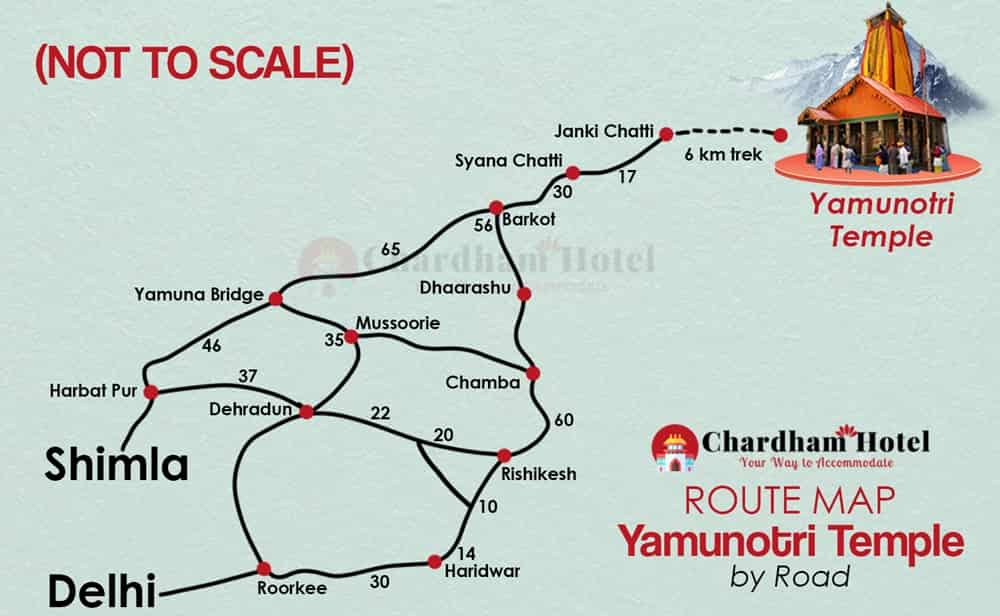
The journey by road always ends at Janki Chatti. From there, everyone — regardless of which city they started in — covers the same 6 km trek.
From Dehradun: Dehradun → Barkot → Janki Chatti → Yamunotri (trek). About 180 km by road plus the 6 km trek. Budget 7–8 hours for the drive and another 2–3 hours for the trek.
From Haridwar or Rishikesh: Same route via Barkot. Haridwar to Yamunotri runs about 220 km by road; Rishikesh is closer, at roughly 210 km. Both routes need 9–10 hours on the road, then 2–3 hours on foot.
From Uttarkashi: Around 125 km by road, 6–7 hours, then the same trek.
Most pilgrims split this into two days — a night in Barkot before tackling Janki Chatti and the trek fresh the next morning. The stretch between Rishikesh/Haridwar and Barkot runs through hill roads with sharp bends, so driving after dark isn’t a good idea, and landslides can close sections briefly during monsoon.
Reaching Yamunotri by Train
Dehradun, Haridwar, and Rishikesh all have railway stations, and none of them is officially designated the “nearest” over the others — pick whichever has the better connection from your city. From any of the three, you continue by road exactly as described above: to Barkot, then Janki Chatti, then the 6 km trek.
Book your onward taxi from the station in advance if you’re travelling in May or June. Demand for cabs spikes the moment trains pull in during peak season, and you don’t want to be negotiating a fare at a crowded stand.
Reaching Yamunotri by Helicopter
Chartered helicopters run from Dehradun for pilgrims who want to skip most of the road journey. Booking goes through the official IRCTC Heli Yatra portal (heliyatra.irctc.co.in), which is the same link the Uttarakhand government’s own registration site points to — so this isn’t a third-party workaround, it’s the sanctioned channel.
The helicopter lands at Kharsali, not at the temple. Kharsali is also the winter seat of Goddess Yamuna and home to an old Shani Temple — worth a look if your schedule allows it. From Kharsali you still need ground transport to Janki Chatti and the same 6 km trek from there; flying doesn’t remove the walk, it removes most of the road drive. Exact flight duration isn’t published by any official source and depends on the operator and the day’s weather, so don’t lock in a tight same-day return flight or train connection.
This route suits pilgrims short on time or uneasy about the long road drive. It doesn’t suit anyone expecting to avoid the trek entirely — that part stays the same no matter how you arrive at Kharsali.
Distance at a Glance
| From | To Yamunotri | Road Distance | Final Trek |
|---|---|---|---|
| Dehradun | Yamunotri | ~180 km | 6 km |
| Rishikesh | Yamunotri | ~210 km | 6 km |
| Haridwar | Yamunotri | ~220 km | 6 km |
| Uttarkashi | Yamunotri | ~125 km | 6 km |
| Delhi | Yamunotri | 400+ km via Rishikesh/Haridwar, route dependent | 6 km |
These are the Uttarakhand government’s own route figures. Delhi isn’t on the official chart directly — it’s given here as an approximate range since the exact number shifts depending on which road you take out of Delhi and which town you route through.
Best Time to Visit
April to June and September to November are the reliable windows — the weather holds and the roads stay in decent shape. Late July through August brings the monsoon, and that means a real risk of landslides on the hill stretches between Rishikesh and Barkot. It’s not that travel is impossible during those months, but if you have any flexibility at all, avoid them. The temple shuts entirely through winter once snow closes the route.
Common Mistakes to Avoid
- Assuming you can register at the temple gate if you skip it earlier — you can register en route, but don’t plan on it; do it before you leave.
- Treating the helicopter as a way to skip the 6 km trek. It isn’t. It only cuts the road drive.
- Booking a tight return flight or train right after your helicopter slot, with no buffer for weather delays.
- Driving the Rishikesh–Barkot stretch after dark on unfamiliar hill roads.
- Skipping a hotel booking in Barkot or Janki Chatti during May–June, when rooms sell out fast.
- Relying only on digital payments — network coverage drops out in the hills, and pony/palki operators often expect cash.
Practical Tips
Warm layers matter regardless of season — Himalayan weather shifts quickly even in what looks like a mild month on paper. Wear trekking shoes that are already broken in, not new ones. Carry your own medication; medical support exists at points along the route, but don’t count on it stocking anything specific to your condition. Agree on the pony or palki fare before you start, rather than after you’ve committed to using one.
Nearby Places Worth the Detour
- Saptarishi Kund — a high-altitude glacial lake connected to the Yamuna’s upper source region, reached by a demanding trek.
- Divya Shila — the sacred rock pillar pilgrims pay respects to before entering the temple.
- Surya Kund — a natural hot spring where devotees cook rice as an offering.
- Kharsali — the winter seat of Goddess Yamuna, with an old Shani Temple; also where the helicopter lands.
- Hanuman Chatti — a base point for trekkers heading toward Dodital.
- Barkot — good overnight stop, with wide views of the Bandarpunch range.
Planning the Stay
Barkot, Janki Chatti, and Kharsali rooms go fast once the season opens, and last-minute rates climb accordingly. If you’d rather not chase availability yourself, Chardham Hotel lists verified stays along this exact route.
FAQs
Can we go to Yamunotri by car?
No. Janki Chatti is the last point a vehicle can reach; the remaining 6 km is on foot, pony, or palki.
When does Yamunotri open in 2026?
19 April 2026. The closing date hasn’t been officially announced yet — check the government portal before finalising travel plans for late in the season.
Is registration mandatory?
Yes, and it’s free. You can register online, through the app, at a registration centre, or with a Yatri Mitra volunteer. If you forget, you can still do it while travelling.
What documents do I need to register?
Aadhaar card, Voter ID, Driving Licence, or Passport, plus a mobile number.
Is there an age limit for registration?
Yes — 10 to 65 years.
How far is the trek from Janki Chatti?
6 km, one way, on foot, pony, or palki.
Does the helicopter avoid the trek?
No. It lands at Kharsali, which still leaves the same 6 km trek from Janki Chatti. It cuts the road drive, not the walk.
Where do I book the Yamunotri helicopter?
Through the official IRCTC Heli Yatra portal, linked directly from the Uttarakhand government’s registration site.
Which railway station is closest to Yamunotri?
Dehradun, Haridwar, and Rishikesh are all listed as access points by the state government — none is designated as officially nearer than the others.
Is the road safe during monsoon?
Landslides are a real risk on the Rishikesh–Barkot stretch in late July and August. Travel outside that window if you can.
Is there a fee for Char Dham registration?
No. The official portal confirms registration is free.
What’s the best time to visit Yamunotri?
April to June, or September to November.
Conclusion
However you get there, the last 6 km from Janki Chatti stays on foot, pony, or palki — road, train, and helicopter all funnel into that same walk. Register before you go, plan around the April–June or September–November window, and if you’re flying in, leave slack in your schedule for weather. Everything else about this trip is manageable once those three things are settled.
Suggested to Read:
- Accommodation Options in Yamunotri Dham
- Best Places to Visit in Yamunotri
- Best Alternate Routes for Chardham Yatra 2026 During Heavy Rush


 Call
 Enquiry