
Yamunotri is the first stop on the Char Dham Yatra — and its 6 km trek from Janki Chatti to the temple at 3,293 metres is one that stays with you long after you’re home. Whether you’re a first-time pilgrim or a seasoned trekker, this guide covers everything: the route step by step, real difficulty level, pony and palki costs, what to pack, 2026 opening dates, and the safety details that most other guides leave out.
Yamunotri Trek: Quick Facts
| Detail | Information |
| Starting Point | Janki Chatti |
| Trek Distance | 6 km (one way) |
| Altitude of Temple | 3,293 metres (~10,800 ft) |
| Elevation Gain | ~700 metres |
| Trek Duration | 3–5 hours (one way) |
| Difficulty Level | Moderate |
| Temperature – Summer | 12°C to 20°C |
| Temperature – Winter | 0°C to 5°C |
| Temple Opens 2026 | April 19, 2026 (Akshaya Tritiya) |
| Temple Closes 2026 | ~November 11, 2026 (Bhai Dooj) |
| Nearest Railway Station | Rishikesh (~175 km) |
| Nearest Airport | Jolly Grant Airport, Dehradun (~170 km) |
Best Time to Visit Yamunotri Dham
The best time to visit Yamunotri Dham is from May to June and September to October. The temple opens on Akshaya Tritiya and closes on Bhai Dooj. It remains shut from November to April due to heavy snowfall. Avoid monsoon months (July–August) because of landslides and slippery routes.
Yamunotri Dham Trek Route
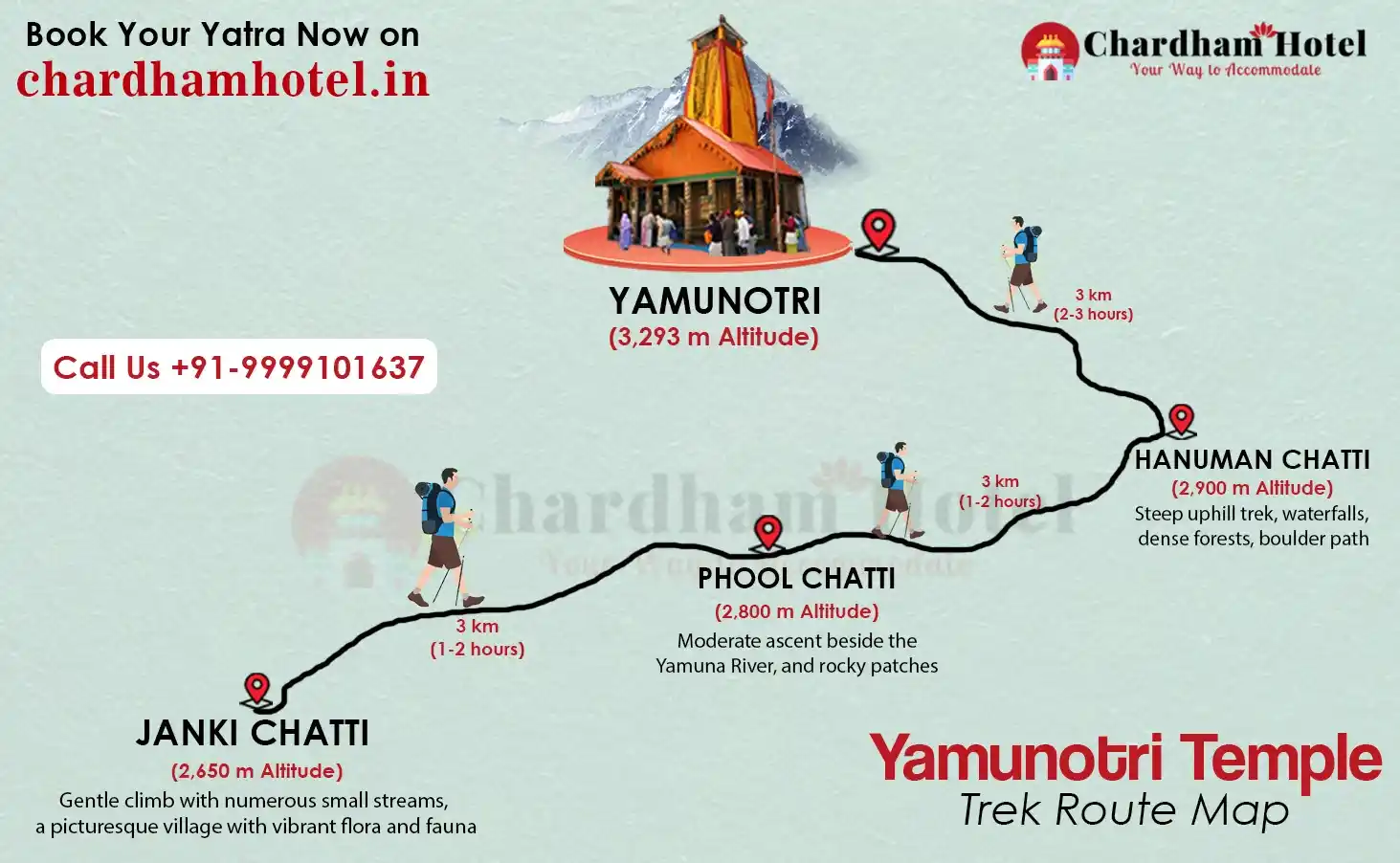
The trek begins at Janki Chatti and runs mostly along the right bank of the Yamuna River. Here is what to expect at each stage:
| Stage | Cumulative Distance | Key Landmark | What to Expect |
| Janki Chatti → Phool Chatti | 0–2 km | Phool Chatti | Gradual climb, river on your right, first tea stalls |
| Phool Chatti → Hanuman Chatti | 2–4 km | Hanuman Chatti | Steady ascent, more rest points, good place to pause |
| Hanuman Chatti → Steel Bridge | 4–5.5 km | River tributary bridge | Route splits: Markandeya Tirtha or Kharsali village |
| Steel Bridge → Yamunotri Temple | 5.5–6 km | Yamunotri Temple | Steep final ascent — most physically demanding stretch |
The trail passes through forests, past moving mountain streams, and along Himalayan slopes. The peaceful atmosphere — pilgrims singing devotional songs, the sound of waterfalls, snow-covered peaks coming closer — makes this one of the most memorable short treks in Uttarakhand.
At Hanuman Chatti, two paths diverge: one via Markandeya Tirtha and one via Kharsali village. Both lead to the Yamunotri Temple. The Markandeya Tirtha route is more commonly taken.
How to Reach Janki Chatti (Trek Base Point)
Janki Chatti is the base point for the Yamunotri trek. You first need to reach Dehradun, Haridwar, or Rishikesh, all of which have good transport links from Delhi and major cities.
| From | Mode | Distance to Janki Chatti | Approx. Time |
| Delhi | Bus / Private Car | ~430 km | 10–12 hours |
| Dehradun | Bus / Shared Jeep | ~170 km | 5–6 hours |
| Haridwar | Bus / Taxi | ~200 km | 6–7 hours |
| Rishikesh | Bus / Shared Jeep | ~175 km | 5–6 hours |
| Barkot | Shared Jeep / Local Taxi | ~35 km | 1–1.5 hours |
From Hanuman Chatti, local taxis and shared jeeps are available to Janki Chatti. Barkot (35 km from Janki Chatti) is the recommended overnight halt the evening before the trek.
Step-by-Step Guide: Yamunotri Trek from Janki Chatti
- Step 1 – Reach Janki Chatti by bus, shared jeep, or private taxi from Dehradun, Haridwar, Rishikesh, or Delhi.
- Step 2 – Your trek begins with a gradual climb alongside the Yamuna River, passing through scenic forests and past waterfalls.
- Step 3 – At 2 km, you reach Phool Chatti. Tea stalls and refreshment points are available here. Take a short rest — don’t rush.
- Step 4 – Continuing from Phool Chatti, at about 4 km, you reach Hanuman Chatti. More tea stalls and resting points are available here.
- Step 5 – About 5.5 km from Janki Chatti, you’ll see a steel bridge over a tributary of the Yamuna. Cross it — you’re almost there.
- Step 6 – The final 0.5 km is a steep ascent leading directly to Yamunotri Temple. Take it slowly — this is the hardest stretch.
Pony, Palki & Porter: Costs and Availability
Not everyone can or should complete the full 6 km trek on foot. Yamunotri has well-organised alternatives available from Janki Chatti:
| Option | Who It’s For | Approx. Cost (One Way) | Notes |
| Pony / Mule | Pilgrims who can sit but not walk long distances | ₹700 – ₹1,200 | Book at official counter near trek start |
| Palki (Palanquin) | Elderly, mobility-impaired, very young children | ₹1,500 – ₹2,500 | Carried by 4 porters; book early in peak season |
| Porter (luggage) | Trekkers wanting a lighter load | ₹300 – ₹700 | Price varies by weight and distance |
These are approximate rates based on recent seasons. Always book from the official counter at Janki Chatti — not from unlicensed operators who may charge more.
Yamunotri Trek Difficulty
The Yamunotri trek is rated moderate. It is not extreme, but it demands real effort — especially for those not used to hill walking. The 6 km route involves an elevation gain of approximately 700 metres, steep ascents, rocky and uneven terrain, narrow ledges, and concrete ramps. Cold winds at higher elevations add to the challenge.
If you can walk briskly for 45 minutes without getting breathless at sea level, you should be able to handle this trek with regular rest stops. First-time trekkers should not take it lightly — even a 6 km walk at altitude is significantly harder than the same distance at sea level.
Important: Altitude sickness can affect anyone above 2,500 metres. If you experience a persistent headache, nausea, or difficulty breathing, stop and rest. Do not push through severe symptoms.
What to Pack for the Yamunotri Trek
- Trekking shoes with non-slip soles and ankle support — the most important item. Flat sandals or casual footwear are unsuitable.
- Trekking poles — reduce knee strain significantly on steep descents.
- Warm layers — even in May and June, mornings and evenings at altitude are cold. Thermal inners are strongly recommended.
- Waterproof jacket / raincoat — mountain weather changes without warning. Always carry one.
- Backpack rain cover — useful when crossing river bridges or during sudden rain.
- Water bottle (1 litre minimum) — refill at tea stalls along the route; stay hydrated throughout.
- Sunglasses and sunscreen (SPF 50+) — UV intensity is high at altitude.
- Torch / headlamp with spare batteries — useful for early morning starts.
- Basic medicines — paracetamol, ORS sachets, altitude tablets (consult a doctor if needed), plasters, antacids.
- Valid photo ID and Char Dham registration slip — mandatory at entry checkpoints.
- Sufficient cash — ATMs are very scarce on the route; withdraw enough in Barkot or Rishikesh before setting out.
Yamunotri Dham Opening and Closing Dates 2026
| Event | Date 2026 | Notes |
| Temple Opens | April 19, 2026 | Akshaya Tritiya — official start of Char Dham Yatra |
| Temple Closes | ~November 11, 2026 | Bhai Dooj — tentative; confirmed closer to date |
| Best Season | May–June and Sep–Oct | Ideal weather, all facilities operational |
| Avoid | July–August | Heavy monsoon, significant landslide risk |
| Winter Closure | November–April | Temple closed; idol moved to Kharsali village |
Places to Stay In and Around Yamunotri Dham
It is essential to book accommodation in advance during the peak pilgrimage season (May–June), as rooms fill up very quickly. Here are the main stay options:
- GMVN Yamunotri Cottages / Dharamshalas — near Yamunotri Temple (within 500 m). Basic but clean.
- Janki Chatti Tourist Rest House — best for trekkers; hot water, parking, and food available.
- Yamunotri Cottages — near Kharsali Helipad; cozy rooms, mountain views, hot water, and food facilities.
- Shiv Shakti Eco Resort, Hotel Bahuguna Palace, La Arkja Premium Villa, Tirath Niwas, Vaishnavi Homestay — all in the Janki Chatti area; a range of comfort levels and price points.
From practical experience: book at least 2–3 weeks ahead during May and June. September–October usually has better availability.
Safety Guidelines and Health Advisory for Trekkers
- Start early — aim to begin by 7–8 AM. Be back at base before dark.
- Don’t rush. Take short breaks every 30–45 minutes. Rushing leads to exhaustion and increases fall risk.
- Avoid alcohol and smoking on the trek — both impair performance significantly at altitude.
- Those sensitive to altitude should plan an acclimatisation night at Barkot (1,220 m) before the trek.
- Very few ATMs in the region — carry sufficient cash from Rishikesh or Barkot.
- Stay well hydrated throughout. At altitude, thirst signals can be muted, but dehydration sets in fast.
- Maintain cleanliness — do not litter on the trail or near the temple complex.
Spiritual Etiquette
- Dress modestly. Avoid revealing clothing at the temple complex.
- Remove footwear before entering any place of worship.
- Be patient in queues — do not push or create disorder in crowds.
- Photography is welcome on the trail but be mindful near sacred sites. Always ask permission before photographing local residents.
Things to Keep in Mind for a Hassle-Free Journey
- Check the weather forecast before starting. Mountain weather can shift dramatically within a few hours.
- Travel light. A heavy backpack will make the ascent significantly harder.
- Try Garhwali food at local dhabas — simple, filling, and a genuine part of the Yamunotri experience.
- Interact with local people. They know the mountains, the weather, and the trails better than any guidebook.
- If time permits, visit Gangotri next — or plan to complete the entire Char Dham pilgrimage.
Frequently Asked Questions
Q-1: Can senior citizens or differently-abled pilgrims do the Yamunotri trek?
Yes. Palkis (palanquins) and pony rides are available from Janki Chatti for seniors and those with mobility challenges. Porters are also available for additional support. Book from the official counter to ensure fair, regulated rates.
Q-2: Is there food and water available during the climb?
Yes. Refreshment stalls at Phool Chatti and Hanuman Chatti serve chai, biscuits, maggi, and light snacks. Always carry your own water bottle and refill at stalls — don’t rely entirely on vendor availability.
Q-3: Is Yamunotri safe for solo travellers?
Yes. The route is well-trafficked during the pilgrimage season and generally safe. Trek during daylight hours, inform someone of your plan, and keep your phone charged. BSNL has the best signal in this region.
Q-4: When is the best time to visit — and which months should I avoid?
The ideal windows are May–June and September–October. Avoid July and August. Heavy monsoon rainfall makes trails dangerously slippery and the route is prone to landslides. The risk during peak monsoon is real, not just an inconvenience.
Q-5: Is registration required for the Yamunotri trek?
Yes. Char Dham Yatra registration is mandatory for all pilgrims. Register online at registrationandtouristcare.uk.gov.in or at offline counters in Haridwar, Rishikesh, or Barkot. Registration is completely free.
Q-6: What medical help is available on the trek route?
Basic first aid is available at Janki Chatti. Medical support directly on the trail is minimal. Carry your own medicines and consult a doctor before the trip if you have any existing health conditions or concerns about altitude sickness.
Q-7: How long does a complete Yamunotri darshan trip take?
A full day from Janki Chatti — trek up, darshan, and descent — takes approximately 8–10 hours. Most pilgrims prefer to spend at least one night at Janki Chatti or Barkot for a more relaxed and comfortable experience.
Are you all set to begin your spiritual trek? Share this guide with your group and plan your Yamunotri Yatra with confidence. Check our Char Dham registration guide, Janki Chatti accommodation options, and Char Dham Yatra packages to complete your planning.


 Call
Call Enquiry